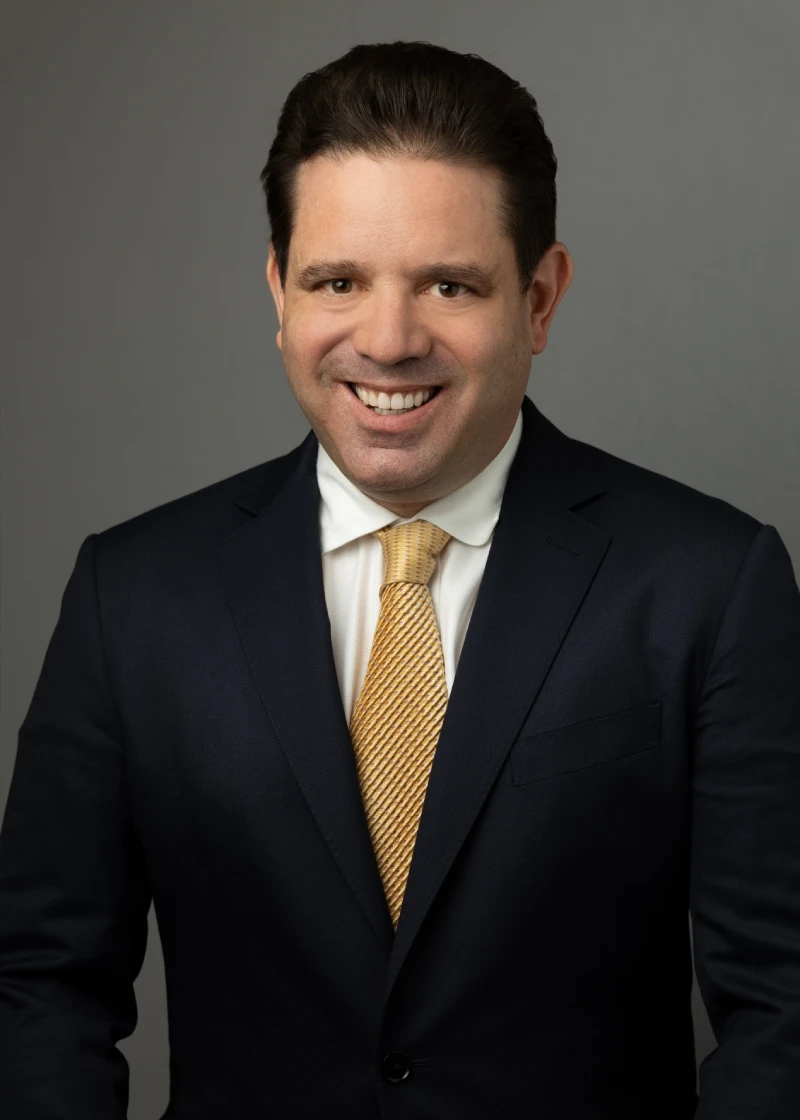
Douglas H. Sanders is a Founding Partner of Sanders Grossman Law. A second-generation attorney, he has spent more than two decades building and leading high-volume litigation practices. His experience spans personal injury, mass torts, and complex litigation, as well as state, federal, administrative, and appellate practice.
PRACTICE AREA SPECIALTIES
Personal Injury
Car Accidents
Workers’ Compensation
Medical Malpractice
Construction Fall Injuries
Nursing Home Abuse
About Douglas Sanders
Mr. Sanders graduated with honors from Duke University in 1996 and earned his law degree from George Washington University Law School in 2000. While in law school, he interned at the U.S. Department of Justice, where he worked on the Oklahoma City bombing case and earned distinguished marks for his performance.
After law school, Mr. Sanders joined his family’s firm, Sanders, Sanders, Block, Woycik, Viener & Grossman, P.C., where he handled a large volume of personal injury cases. He supervised the pleadings and motions departments, attended court conferences, and conducted depositions. In 2001, he joined Sanders & Grossman, P.C. to practice no-fault medical billing collections. He became the firm’s operations managing partner, overseeing human resources, technology, program development, and legal process. He continued in that role as the firm grew through a series of mergers into Sanders Barshay Grossman, L.L.C.
Mr. Sanders has also played a key role in the firm’s mass tort practice. As a member of Sanders Viener Grossman, LLP, he handled heavy motion work and appellate practice. He later oversaw the mass torts division from the firm’s Puerto Rico office. In 2016, he spoke at the Puerto Rico Investor Summit alongside leading legal minds, entrepreneurs, elected officials, and global business leaders.
Known among his peers as both a skilled lawyer and an experienced operations manager, Mr. Sanders is committed to honesty, integrity, and the efficient, effective handling of every client’s claim. He is admitted to practice in New York, Arizona, Georgia, Kentucky, Massachusetts, Michigan, Ohio, and Washington, as well as the U.S. District Court for the Southern District of New York.